UN38.3
UN Manual of Tests and Criteria: Section 38.3
Required for air, sea, and road transport of lithium batteries as Class 9 Dangerous Goods. Without this certification, batteries cannot be shipped internationally. Valid for 5 years per cell/pack design.
- Jurisdiction
- International
- Applies to
- Global Air freight Sea freight Road freight
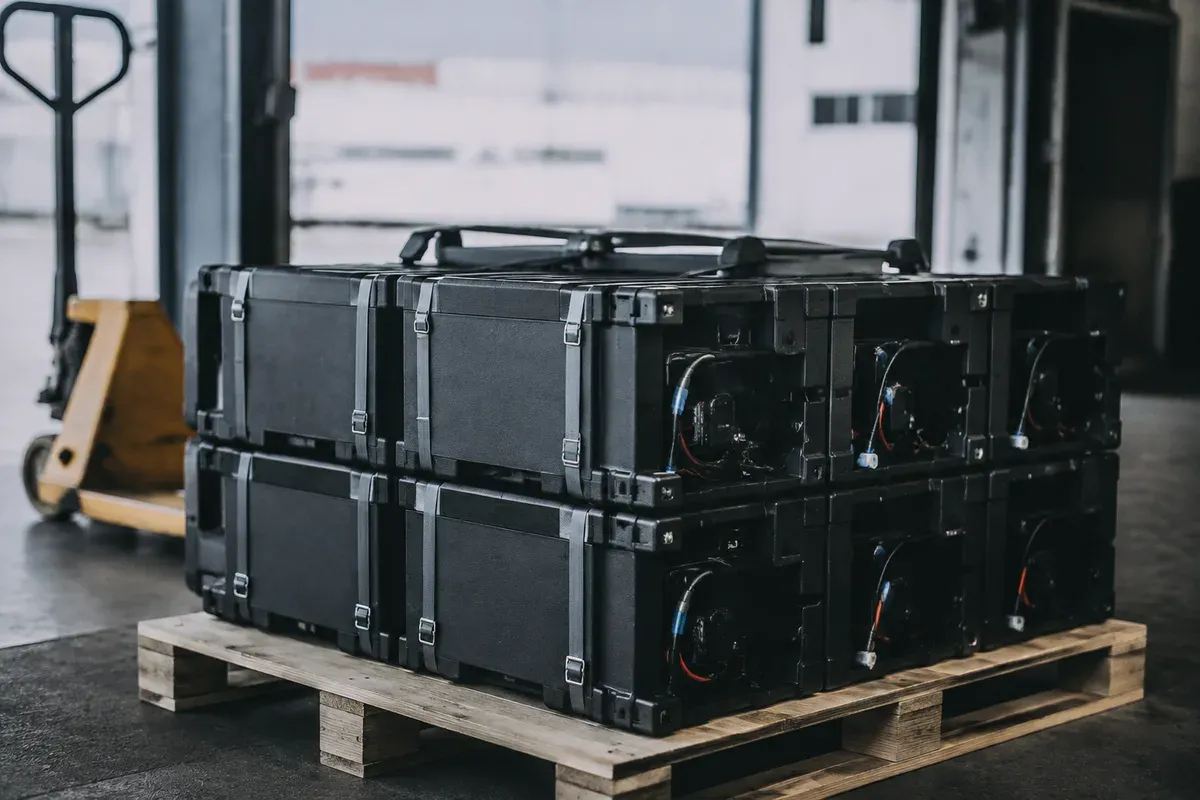
The eight tests behind the report
UN38.3 is section 38.3 of the UN Manual of Tests and Criteria, and it is the gate for moving lithium batteries as Class 9 dangerous goods. A pack design is subjected to eight tests, run in sequence on the same samples:
- T1 Altitude simulation — low pressure, simulating unpressurised air cargo
- T2 Thermal test — repeated cycling between temperature extremes
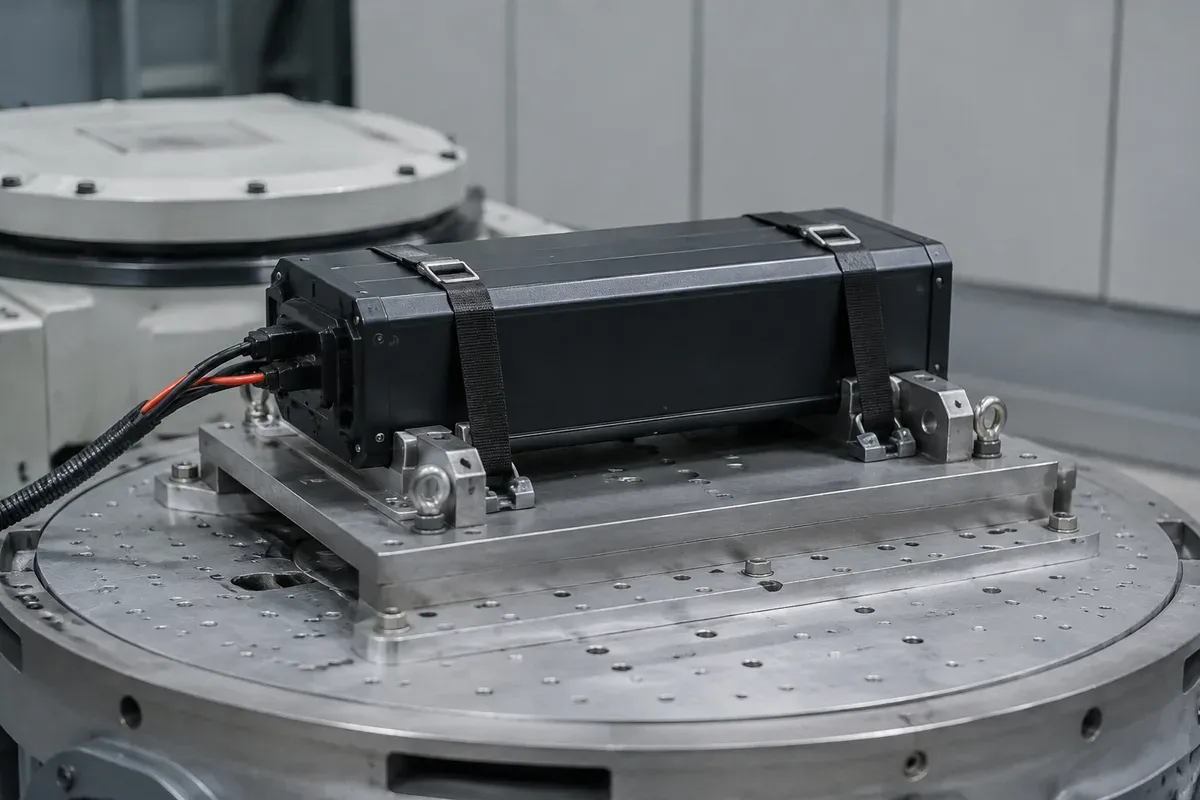
- T3 Vibration — simulating transport over road, sea, and air
- T4 Shock — mechanical impact
- T5 External short circuit
- T6 Impact / crush — cell-level mechanical abuse
- T7 Overcharge — battery-level
- T8 Forced discharge — cell-level
T6 and T8 apply at cell level; T7 applies to the assembled battery. Passing means no leakage, no venting, no disassembly, no rupture, no fire, and voltage retention within the defined limit.
The report is tied to a design, not to your order
This is the point buyers most often get wrong. A UN38.3 report covers one specific pack design: cell model, configuration, enclosure, and BMS. Change the cell supplier, the series-parallel arrangement, or the enclosure, and the report no longer covers what you are shipping. A supplier handing over a UN38.3 report for a different pack is handing over a document that will not survive scrutiny.
Since 2020 a Test Summary must be made available by anyone offering these cells or batteries for transport. It names the manufacturer, the cell or battery description, the mass, the watt-hour rating, the test laboratory, the report number and date, and the list of tests passed. Freight forwarders increasingly ask for the Test Summary rather than the full report — it is the document that clears the shipment.
What this means for your shipping schedule
Without valid UN38.3 documentation the shipment does not move. Not “moves slowly” — a forwarder that accepts undocumented lithium batteries is taking on liability no reputable operator will accept, and goods stopped at origin still incur storage.
Reports are valid for the design rather than the batch, and are conventionally treated as current for five years, though the operative question is always whether the design still matches. Because the report follows the design, a certification-critical program should freeze the pack specification before testing rather than after — a late cell substitution to solve a supply problem can quietly invalidate the paperwork.
Air freight adds its own layer on top of UN38.3, under IATA packing instructions PI 965 and PI 966, with state-of-charge limits for cells shipped alone. Our guide to shipping lithium batteries by air and sea covers how the two regimes interact and where the cost difference actually falls.
See what the paperwork looks like
We hold a real certificate from our files, issued against one catalog model. Email us and we send it over so you can check the format, the issuing body, and the scope statement before you order. Your order ships with its own documents, issued against your own build — not this one.
UN38.3 test report — sample (model LZB-6S2P-56) Request by emailPacks that ship with UN38.3
- Custom Lithium E-bike Battery Pack — OEM 36V / 48V / 52V
- 48V E-bike Battery Packs 48V
- 36V Seatpost E-bike Battery 36V
- 52V High-Capacity E-bike Battery 52V
- Silver-Fish Replacement E-bike Battery 36V / 48V / 52V
- KT-E57 Integrated-Frame E-bike Battery 48V
- KT-E60 Integrated-Frame E-bike Battery 48V / 52V
- KT-E60-PRO High-Capacity Integrated Battery 48V / 52V
- KT-E09 Down-Tube E-bike Battery 48V
- KT-E09-PRO Down-Tube E-bike Battery 48V
- KT-E33 52V Down-Tube E-bike Battery 52V
- KT-E33-PRO 52V Down-Tube E-bike Battery 52V
- KT-S01 36V Seatpost E-bike Battery 36V
- KT-S02 36V Seatpost E-bike Battery 36V
- KT-D02 Silver-Fish Replacement Battery 36V / 48V (series count per programme)
- KT-D15 Silver-Fish Replacement Battery 36V / 48V (series count per programme)
Need the UN38.3 package for your build?
Tell us your target markets and pack specification. We confirm which documents ship as standard, which need advance scheduling, and what each one will cost you in lead time before you commit.
Related certifications
Material Safety Data Sheet (SDS: GHS format)
International
CEConformité Européenne (EU Declaration of Conformity)
European Union
IEC62133IEC 62133-2:2017: Secondary cells for portable applications
International
RoHSRoHS 3: Restriction of Hazardous Substances (2015/863/EU)
European Union