Hipot Test
A high-voltage test between the pack's live circuit and its enclosure, verifying that insulation will not break down in service.
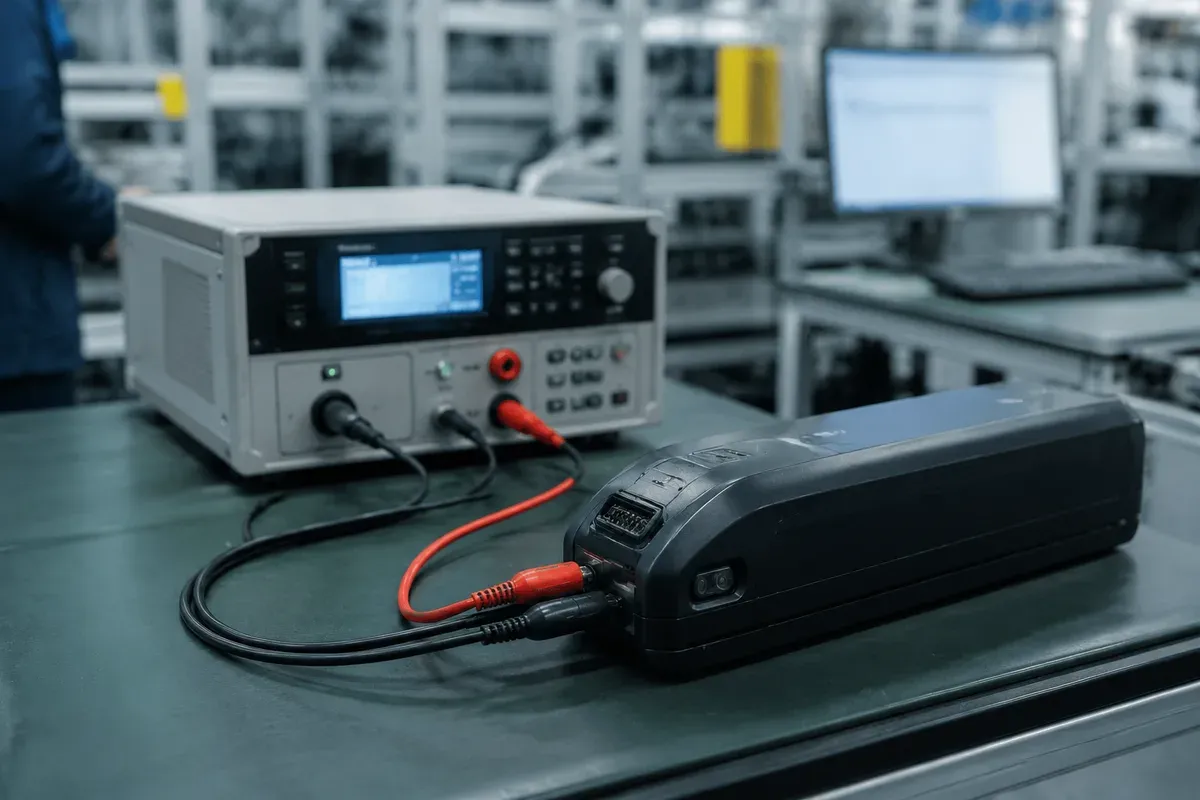
What it checks
Hipot — high potential — applies a voltage far above the pack’s working voltage between the electrical circuit and the accessible metalwork, then measures whether any current leaks across.
It is not testing the battery. It is testing the insulation: the barriers separating live parts from anything a user or the frame can touch. A pack that works perfectly can still have a wire pinched against an enclosure edge, a nicked sleeve, or a creepage distance too short on a BMS board.
Those defects do not affect performance. They affect what happens when moisture gets in, or when vibration finishes what assembly started.
Why an e-bike pack needs it
At 36V to 52V, a pack is below the voltages people usually associate with electrical danger, so buyers sometimes assume insulation testing is irrelevant.
Two reasons it is not. First, insulation failures are a route to short circuits and therefore to thermal runaway — the hazard is fire, not shock. Second, the charger side runs at mains voltage, and the pack sits in a system where a fault path can cross that boundary.
Insulation and clearance requirements appear in the safety standards a pack is tested against, including IEC 62133-2 and UL 2271, so the evidence matters for certification as well as for safety.
Where it sits in production
Hipot is an end-of-line test, run on the finished pack after the enclosure is closed — which is the point, since it is checking assembly outcomes rather than component design.
Done as a 100% test it catches individual assembly defects. Done on a sample basis it catches systematic ones only, which is a meaningfully weaker guarantee for a product where one bad unit is one bad outcome.
Sampled, or every unit?
Ask whether hipot is 100% or sampled, at what test voltage, and whether results are retained per unit.
Retained per-unit results tie into cell traceability: together they let you answer, months later, exactly what was verified on the pack in front of you.
Working on a pack specification?
Send us the voltage, capacity, current draw, and target markets. We reply with a specification you can review rather than a price with no working shown.