Nickel Strip
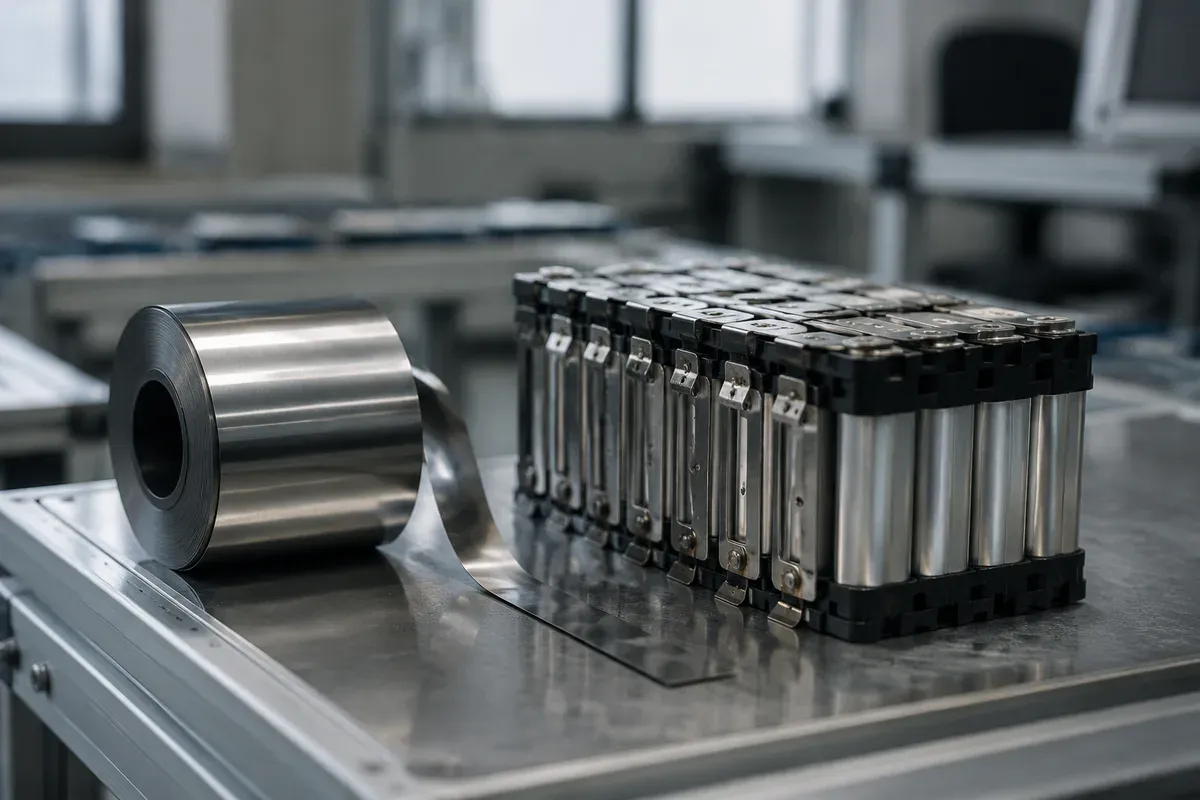
The thin metal ribbon welded between cells to carry current — sized by thickness and width, and a common place to cut cost invisibly.
What it has to carry
Nickel strip connects cells into parallel groups and groups into series. Every amp the pack delivers passes through it.
Two dimensions matter: thickness (commonly quoted around 0.1mm to 0.2mm for e-bike packs) and width. Together they set cross-sectional area, and area sets resistance. Undersized strip adds internal resistance, which becomes voltage sag under load and heat inside the enclosure.
Because heating scales with the square of current, a strip that is comfortable at 15A can be marginal at 40A. Sizing has to follow the peak, not the average.
Pure nickel versus nickel-plated steel
This is where cost is quietly removed from a pack, and it is invisible in a photograph.
Pure nickel has low resistivity and welds cleanly and consistently.
Nickel-plated steel looks identical — same colour, same finish — and costs considerably less. Its resistivity is several times higher, so the same dimensions carry meaningfully more loss, and weld quality is less consistent.
A pack built with plated steel where pure nickel was specified will pass a capacity test and run hotter for its whole life. There is no way to tell by looking.
Multi-layer and busbar construction
High-current packs stack strip in layers or move to solid busbars rather than simply widening a single strip. Layering also improves reliability: a single tab has one failure point, while parallel tabs share the load and tolerate one bad weld.
Get the material in writing
Ask for material and dimensions in writing — “nickel strip” alone is not a specification. Pure nickel, stated thickness, stated width.
Then ask whether joints are resistance-tested rather than visually inspected. Correct material with a bad weld performs no better than the wrong material.
We specify strip against the pack’s peak current, weld with automated equipment, and resistance-test 100% of joints rather than sampling them.
Working on a pack specification?
Send us the voltage, capacity, current draw, and target markets. We reply with a specification you can review rather than a price with no working shown.