Spot Welding
Joining nickel strip to cell terminals with a brief high-current pulse — the standard method for building lithium packs, because soldering overheats cells.
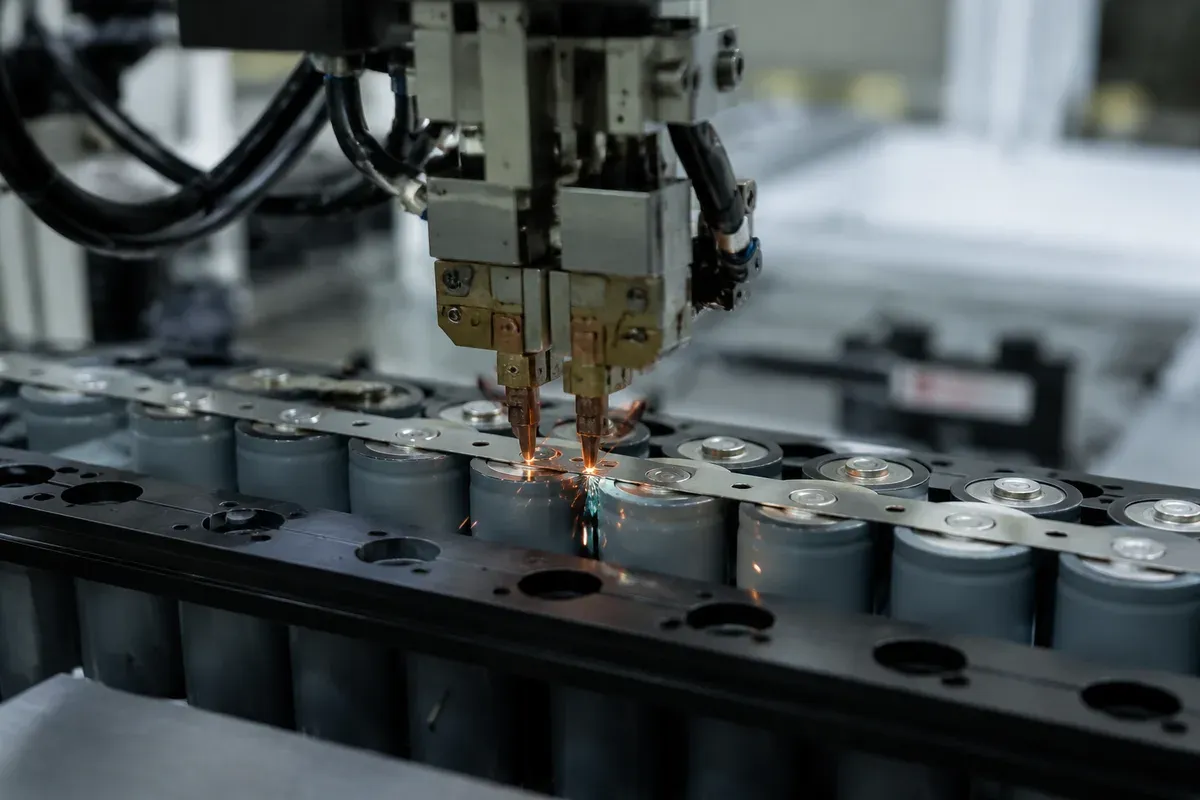
Why welding and not soldering
A soldering iron holds a cell terminal at high temperature for seconds. That heat travels into the cell and damages the internal chemistry near the terminal, degrading capacity and, in the worst case, compromising the separator.
Spot welding delivers a very short, very high current pulse between two electrodes. The heat is concentrated at the interface for milliseconds and dissipates before it reaches the cell interior. Done correctly it produces a strong, low-resistance joint with negligible thermal damage.
This is why hand-soldered packs are a red flag in this industry. It is not a matter of craftsmanship; the method is wrong.
What separates a good weld from a bad one
Every joint carries current, so weld quality directly shapes pack performance and safety.
Resistance. A poor weld has higher resistance, which means it heats under load, wastes energy, and contributes to voltage sag. In a parallel group, an inconsistent weld makes one cell carry less than its share while the others carry more — the group ages unevenly and drifts out of balance.
Mechanical strength. The joint must survive years of vibration. A weld that is strong enough on the bench and marginal in service produces intermittent faults that are extremely hard to diagnose in the field.
Consistency. A pack with 100 cells has hundreds of welds. One bad joint can be enough.
Telling a good process from a good photograph
Ask whether welding is automated or manual, and — the more revealing question — whether welds are tested rather than just inspected visually.
We use automated spot welding with in-line weld resistance checks, and every nickel strip joint is 100% resistance-tested rather than sampled. Cell arrangement is documented per work order, so a joint can be traced back to a batch.
Visual inspection catches gross defects. It does not catch a joint that looks fine and has twice the resistance it should. Resistance testing does.
Working on a pack specification?
Send us the voltage, capacity, current draw, and target markets. We reply with a specification you can review rather than a price with no working shown.