Lithium Plating
Metallic lithium depositing on the anode instead of intercalating — caused mainly by charging cold or too fast, and largely irreversible.
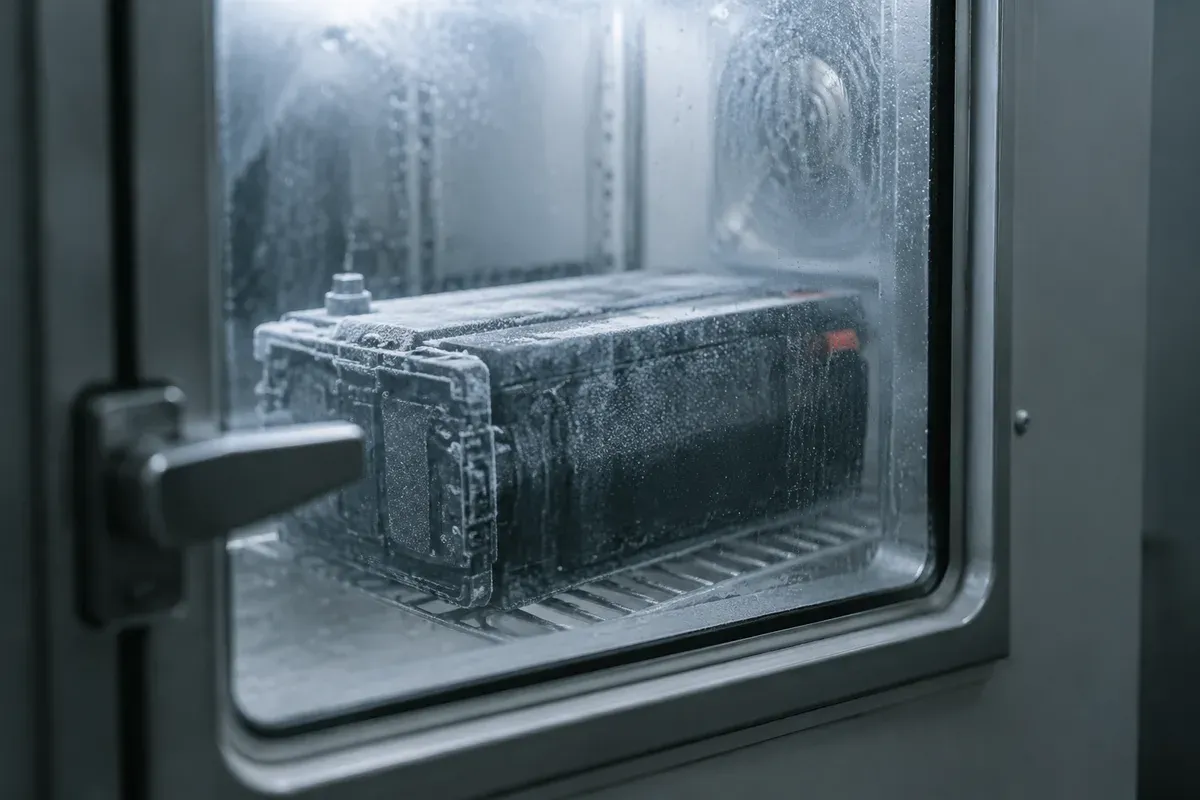
What goes wrong
In normal charging, lithium ions move into the anode’s structure. When the anode cannot accept them fast enough, they instead deposit as metallic lithium on its surface.
Two consequences follow. The plated lithium is mostly lost to circulation, so capacity drops permanently. And the deposits can grow into dendrites — needle-like structures that, if they reach the separator, create an internal short and a credible path to thermal runaway.
This is not a gradual wear mechanism like capacity fade. It is damage, and it is largely irreversible.
When it happens
Three conditions, often in combination:
- Low temperature. Below roughly 0°C, lithium diffusion into the anode slows sharply while the charger keeps pushing current. This is the dominant cause in the field.
- High charge rate. Fast charging pushes ions faster than the anode absorbs them.
- High state of charge. The anode is already full; the last stretch of a charge is the most vulnerable.
Cold plus fast is the worst case, and it is exactly what happens when a rider brings a bike in from a freezing commute and immediately plugs in a high-current charger.
The defence is a BMS rule, not user education
The reliable protection is a low-temperature charging cutoff in the BMS: refuse charge below a threshold, or reduce current in a defined band above it.
Relying on the manual is not a defence. Users charge when convenient, and a pack that permits cold charging will be cold-charged.
Setting the threshold deliberately
State your coldest market and your expected charging environment. Indoor overnight charging in a heated building is a very different risk profile from a bike parked outside a depot in Scandinavia.
Then decide the threshold deliberately. A cutoff set too high frustrates users who cannot charge on a cool morning; set too low or omitted, it quietly destroys packs and produces warranty claims that look like premature failure — because that is what they are.
Working on a pack specification?
Send us the voltage, capacity, current draw, and target markets. We reply with a specification you can review rather than a price with no working shown.