BMS Communication (UART / CAN)
The data link that lets a pack report charge, health, and faults to a display or controller instead of being inferred from voltage alone.
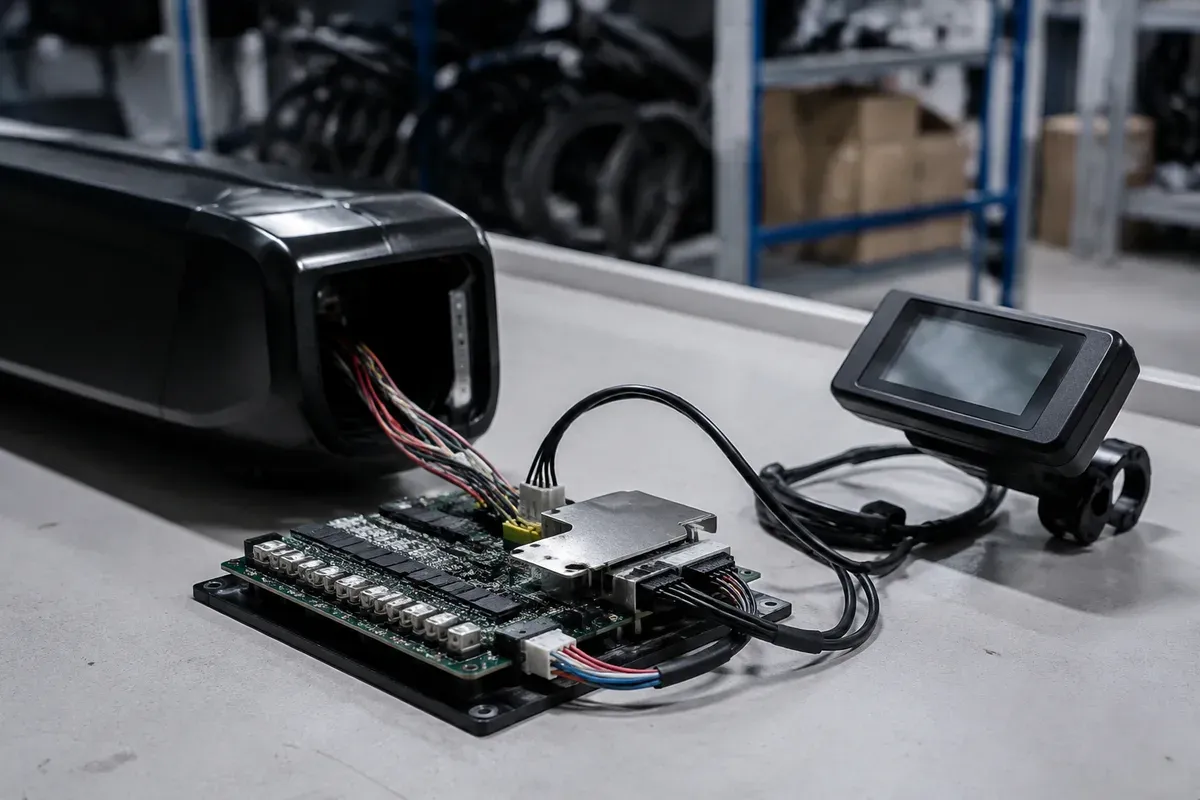
Three levels of integration
Packs sit at one of three levels, and the choice affects cost, capability, and regulatory exposure.
No communication. The pack supplies power; the display estimates charge from voltage. Cheapest, and inherits every weakness of voltage-based state of charge — the gauge dips under load and recovers at rest.
Wired data — UART or CAN. The BMS reports actual values: charge, cell group voltages, temperature, cycle count, fault codes. UART is simple point-to-point and common on e-bike displays. CAN is more robust, multi-device, and standard where several controllers share a bus.
Wireless — usually Bluetooth. Enables a smartphone app. It also converts the pack into an intentional radio transmitter, which brings FCC obligations in the US and equivalent rules elsewhere.
What the data buys you
A communicating pack changes what is possible after the sale, not just during the ride.
Fault codes turn “the battery does not work” into a diagnosis, which shortens warranty handling and reduces the number of packs returned with no fault found. Cycle count and capacity history make state of health measurable rather than arguable — decisive for fleet operators planning replacements.
It also lets the pack and controller negotiate. A controller that knows the pack is cold or nearly empty can limit current gracefully rather than being cut off mid-climb.
The compatibility trap
Protocols are not standardised across this industry. “Supports UART” tells you almost nothing — the message format, baud rate, and command set vary by manufacturer, and two UART devices frequently cannot talk to each other.
Send us the actual protocol documentation for your display or controller, not just the interface name. Where a brand’s protocol is proprietary and undocumented, matching it becomes reverse engineering with an uncertain outcome, and it is far better to know that before the schedule is set.
On OEM programs we can implement your own proprietary protocol, which has the useful side effect of making third-party packs harder to substitute into your bikes.
Working on a pack specification?
Send us the voltage, capacity, current draw, and target markets. We reply with a specification you can review rather than a price with no working shown.