Series-Parallel Configuration (13S4P)
The notation describing how cells are wired in a pack: S groups set voltage, P cells per group set capacity and current capability.
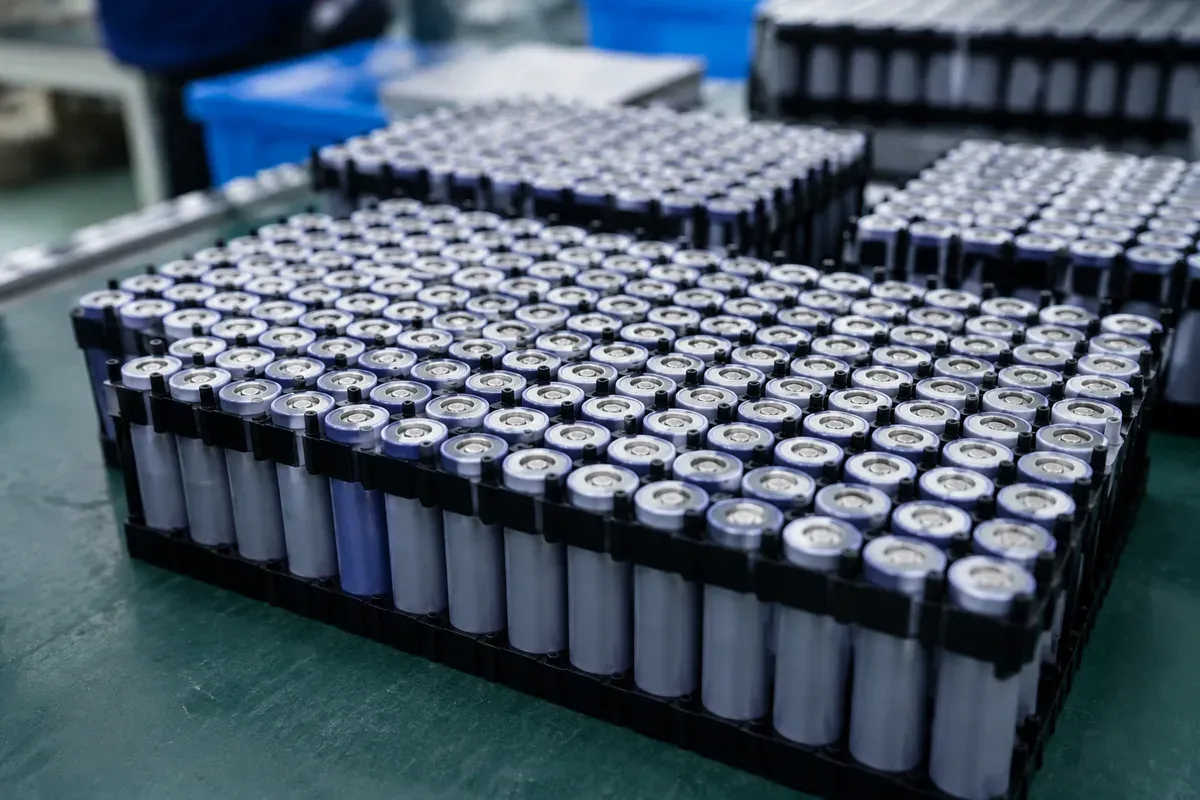
Reading the notation
13S4P means thirteen groups wired in series, each group containing four cells in parallel — 52 cells in total.
The two numbers do different jobs:
- S — series count multiplies voltage. Thirteen groups of a 3.6V nominal cell gives 46.8V, marketed as a 48V pack. Fourteen groups gives 50.4V, marketed as 52V.
- P — parallel count multiplies capacity and current capability. Four cells of 5Ah in parallel behave as one 20Ah group.
So 13S4P at 5Ah per cell is a 48V 20Ah pack, roughly 936Wh.
The part buyers miss
Almost everyone understands that P drives capacity. Far fewer register that P also drives current.
Each cell has a maximum continuous discharge. Put four in parallel and the group can sustain four times that; put eight in parallel and it doubles again. This is why a pack’s continuous current rating is not a free parameter — you cannot specify a small pack with a large sustained draw, because the cells physically will not do it.
It is also why fitting a higher-rated BMS to a low-P pack achieves nothing. The BMS is not the limit; the cell group is. See our 48V range, which runs 13S4P to 13S11P precisely to cover this spread.
The three numbers we need
Give us three numbers: nominal voltage, target capacity in amp-hours, and the continuous and peak current your controller draws. We work back to the configuration and cell that satisfies all three.
Where a physical constraint fixes the cell count — a replacement pack limited by case length, for instance — the arithmetic runs the other way, and the available configurations set the achievable capacity rather than the reverse.
Working on a pack specification?
Send us the voltage, capacity, current draw, and target markets. We reply with a specification you can review rather than a price with no working shown.