Nominal Voltage
The average working voltage a pack is named for — distinct from its fully charged and fully discharged voltages, which is what equipment must actually tolerate.
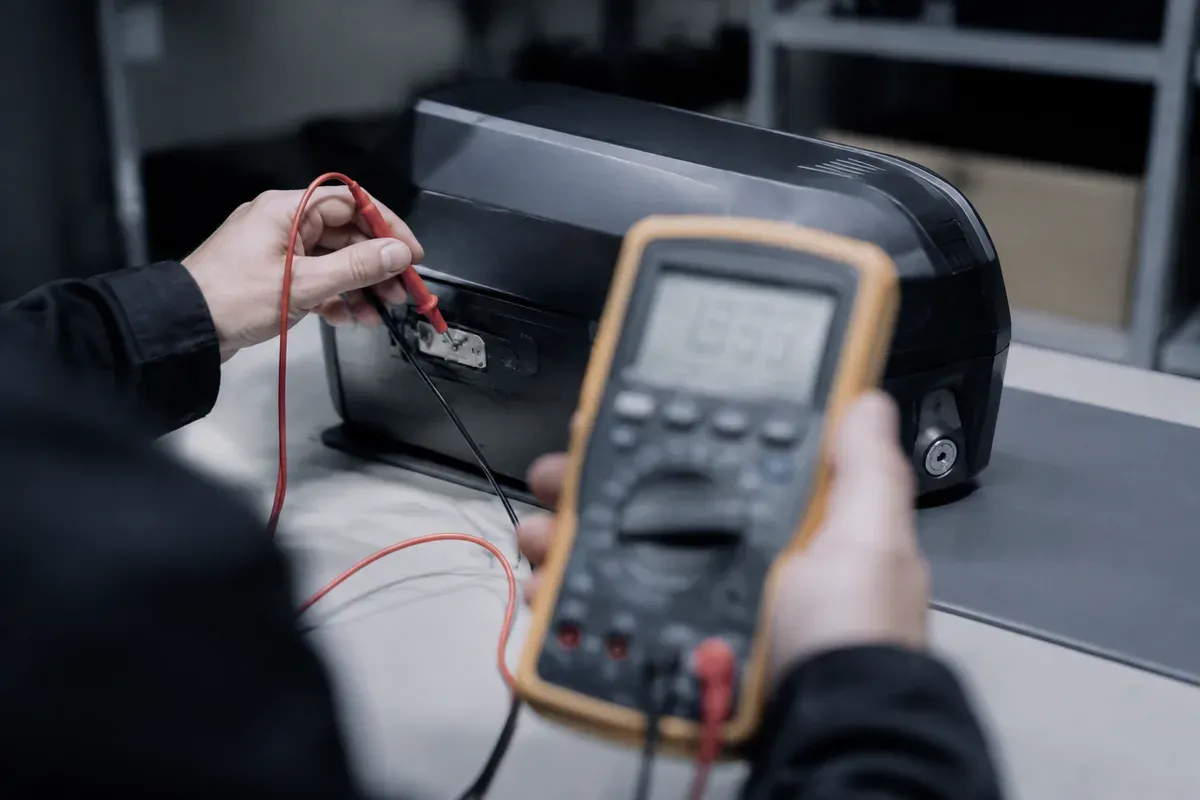
Three voltages, one name
A “48V” pack is never at 48V for long. It has three figures that matter, and only one of them is on the label:
- Nominal — 48V, the marketing name, roughly the average across a discharge
- Fully charged — 54.6V for a 13S lithium pack (13 × 4.2V)
- Cut-off — typically 39V to 42V, where the BMS disconnects the load
The pack spends its working life sliding from the top figure to the bottom one. That slide is the discharge curve, and the shape of it is what a fuel gauge tries to interpret.
Why the charged figure is the one that breaks things
Equipment compatibility is set by the maximum, not the nominal. This is where an upgrade goes wrong.
A 52V pack is 14S, so it charges to 58.8V. A controller specified for a 48V pack may be rated to around 54.6V. Fitting the 52V pack presents it with 58.8V the moment it is fully charged — and it faults, or fails. The pack is not defective and neither is the controller; the specification was never checked against the right number.
Our 48V versus 52V comparison covers the trade in full, and the 52V platform page flags controller ceiling as the first thing to confirm.
What to check
Before committing to a voltage platform, get the controller’s maximum input voltage and the display’s supported range in writing. Compare against the pack’s fully charged figure, not its name.
Charger compatibility follows the same logic: a 13S pack needs a 54.6V charger and a 14S pack needs 58.8V. They are not interchangeable, and a charger that undercharges leaves capacity unused while one that overcharges is a safety problem the BMS should catch but should never have to.
Working on a pack specification?
Send us the voltage, capacity, current draw, and target markets. We reply with a specification you can review rather than a price with no working shown.