Who Makes E-bike Batteries? The Four Types of E-bike Battery Manufacturers
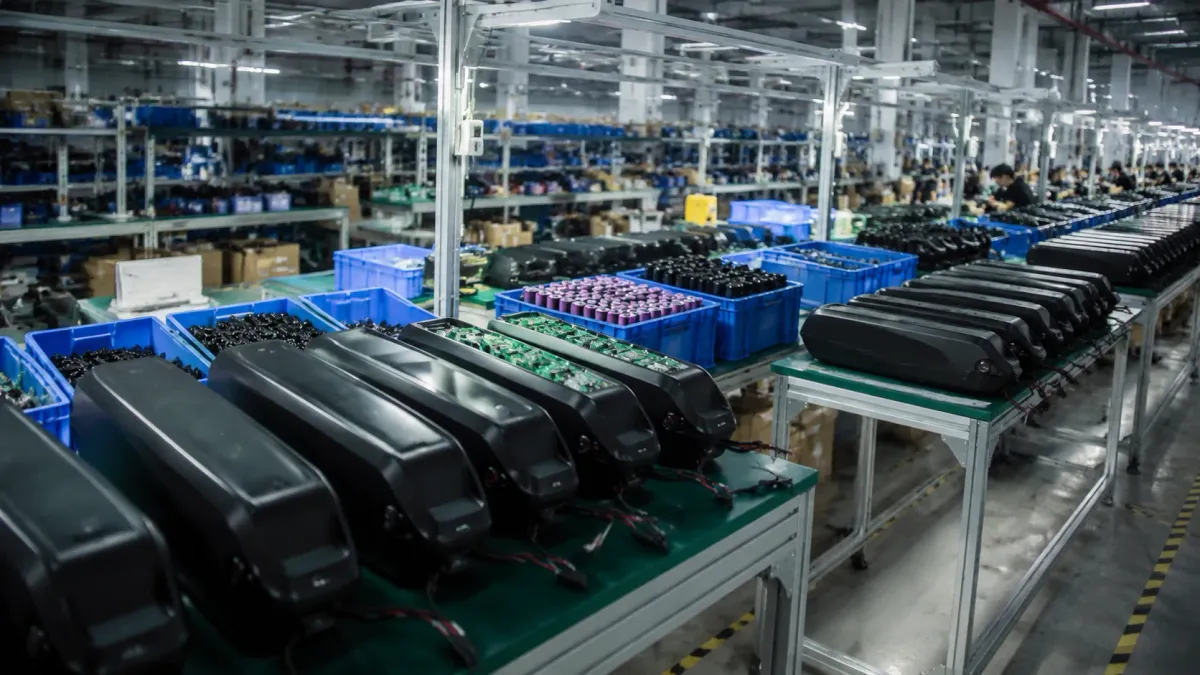
Ask “who makes batteries for e-bikes?” and the honest answer is: four different kinds of companies, and buyers routinely talk to the wrong one. An e-bike brand planning 5,000 packs a year, a repair shop needing one silver-fish replacement, and a startup speccing its first cargo bike all search the same term — but they need entirely different suppliers.
This guide maps the four manufacturer types, names representative players in each, and closes with the two questions that tell you which type to contact. If you already know you need a production partner, our due-diligence guide to choosing an OEM manufacturer picks up from there.
Type 1: Drive-system brands with proprietary batteries
Bosch, Shimano, and Yamaha build batteries as one half of a closed drive system: the pack, motor, controller, and display are engineered together and certified as a unit. Bosch’s PowerTube, Shimano’s STEPS down-tube packs, and Yamaha’s integrated batteries are only available to bike brands that adopt the whole system.
Choose this type if you are an e-bike brand committing to a Bosch/Shimano/Yamaha drivetrain — the battery comes with it. The trade-off is lock-in: proprietary mounts, proprietary BMS communication, and no control over cells or cost structure. These companies do not build packs for third-party programs, so if you want your own battery specification, this tier is a dead end.
Type 2: Cell manufacturers
Samsung SDI, LG Energy Solution, Panasonic, EVE, and CATL make the cylindrical 18650 and 21700 cells inside most quality packs. They manufacture the fundamental energy-storage component, not the finished e-bike battery — and with rare exceptions they do not sell small volumes or assemble packs for e-bike brands.
Their role in your sourcing decision is upstream but decisive: the cell brand and grade inside your pack determine its real capacity, cycle life, and safety behavior. Whatever pack supplier you choose, the questions that matter are which of these makers’ cells are inside and whether the supplier can prove it with traceability documents. Our cell brands and grades guide explains what the grade letters on a datasheet actually mean.
Type 3: Large-scale OEM/ODM pack assemblers
This is the layer that turns cells into finished, certified e-bike batteries at production volume. Companies like BMZ Group in Europe and Simplo Technology or Reention/JoyCube in Asia buy cells from Type 2 makers, design or license enclosures and BMS hardware, and assemble packs for bike brands under OEM (your design) or ODM (their platform, your label) arrangements.
This is the right tier for most brands, importers, and fleet operators — and it is the tier Lizo Power operates in. The evaluation criteria here are different from consumer buying: in-house BMS design, documented cell traceability, certifications matched to your exact pack, MOQ and sampling terms, and production capacity. Because this tier ranges from genuine engineering factories to trading companies with a logo, verification matters more than the quote — see how to tell a real factory from a re-labeler and how to verify a supplier’s certificates.
Type 4: Specialized custom and aftermarket builders
Builders like EM3ev, Amorge, and Bicycle Motor Works assemble high-performance or one-off packs in small batches, often for conversion kits, performance builds, and aftermarket replacement. They will work from unusual cell requests, odd enclosure dimensions, and order quantities of one.
Choose this type if you need a single custom battery, a small pilot batch, or a replacement for a discontinued pack. Per-unit cost is higher and production certifications are typically lighter, but that is a fair trade at prototype scale — many OEM programs start here for validation before moving to a Type 3 assembler for volume. Our silver-fish replacement battery line covers the case where you need a removable aftermarket pack built to a specific length and connector.
Two questions that pick your supplier type
Every sourcing conversation in this market resolves to two forks:
- Mass-production program or single custom battery? Volume with recurring orders points to a Type 3 OEM/ODM assembler; one-off or small-batch needs point to a Type 4 builder.
- What voltage and capacity does the application need? 36V suits light city and folding bikes, 48V is the most compatible all-round platform, and 52V serves cargo and performance builds — the answer determines which enclosure platforms and cell layouts are even candidates. Our 48V vs 52V comparison walks through the trade-offs, and the voltage and capacity glossary covers the arithmetic behind the labels.
If your answers are “production volume” and “36–52V”, that is precisely the program profile we build for. Send us your spec sheet with voltage, capacity, enclosure constraints, and target market, and we will respond within one business day with a fit assessment and preliminary quote.